 A2A Fans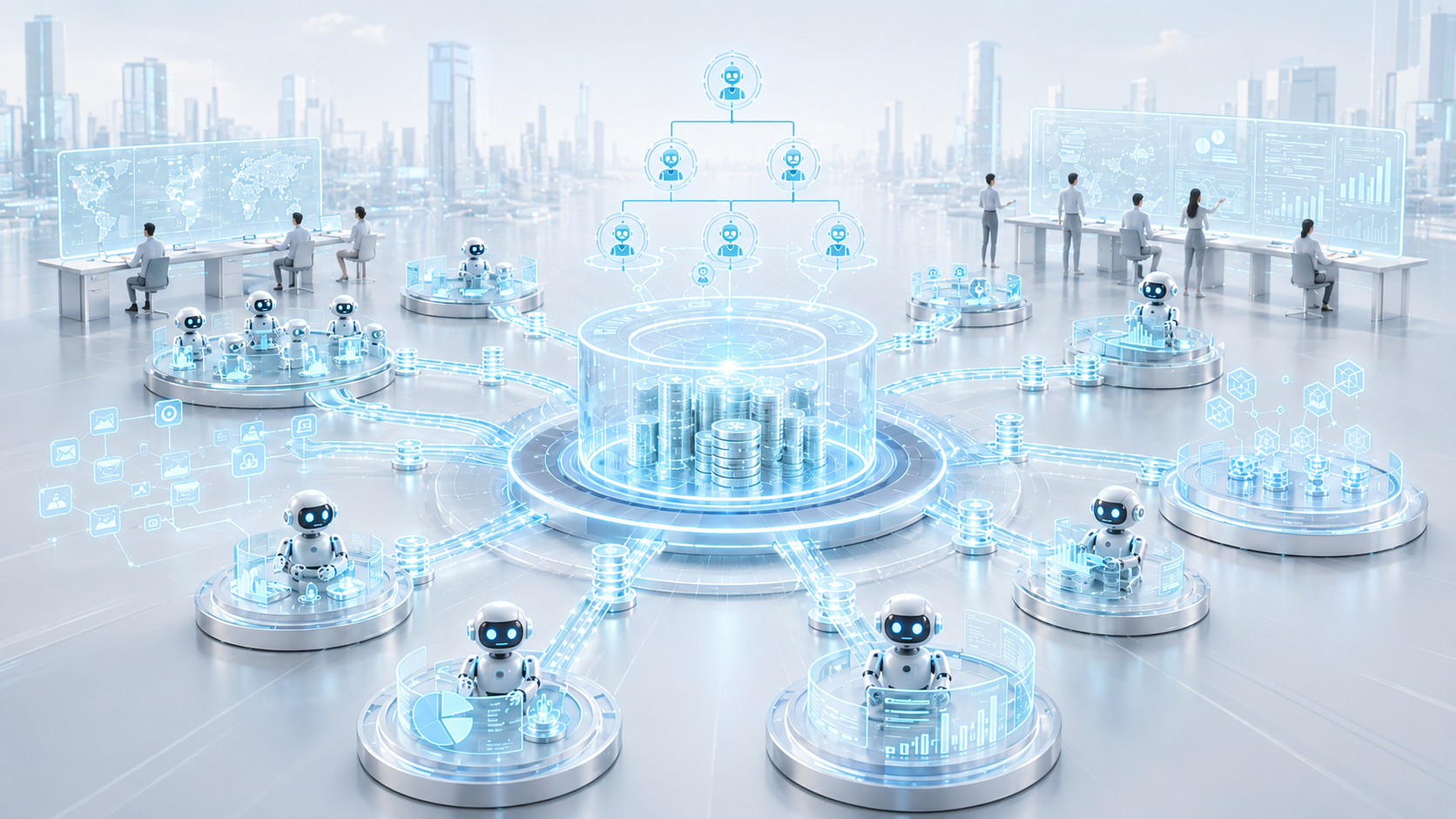
Introduction
A single capable agent can indeed manage a variety of tasks effectively. However, when it comes to complex work, the requirements often extend beyond the capabilities of a solitary agent. Such intricate tasks frequently demand a combination of different skills, the ability to work in parallel, specialized knowledge, or a clear delineation of responsibilities among various agents. This is precisely where multi-agent systems prove to be invaluable. A multi-agent system consists of a collective of AI agents that work together to divide, coordinate, and successfully complete tasks that no single agent can reliably handle on its own. For instance, one agent may take on the role of planning, while another focuses on research, a third agent is responsible for writing, and a fourth agent conducts reviews. The overall success of the system relies less on the performance of any individual model and more on the collaborative efforts of the agents and the orchestration of the entire system.
As we look ahead to 2026, the conversation surrounding multi-agent systems has grew significantly, moving beyond mere demonstrations. Teams are now focused on practical patterns that can actually be deployed in production, considering factors such as token costs, potential failure modes, observability, and the integration of protocols like MCP and A2A within the overall technology stack. This guide aims to explore the fundamental concepts, the primary orchestration patterns, the practical ways in which agents collaborate, and the best practices that distinguish robust, functioning systems from those that are merely fragile experiments.
Key Takeaways
Multi-agent systems trade simplicity for specialization, parallelism, and clearer responsibility boundaries.
The dominant production pattern is still orchestrator–worker (supervisor + specialists).
MCP equips each agent with tools and data; A2A enables discovery and hand-off between independent agents.
Most failures come from unclear roles, unbounded loops, shared-state collisions, and missing verification.
Start with the fewest agents that solve the problem, measure, and then expand.
What Is a Multi-Agent System?
A multi-agent system is composed of numerous autonomous or semi-autonomous agents that engage in interactions with one another to collectively achieve a common objective or goal. Each individual agent usually possesses a specific and focused role within the system, has its own context window that defines its operational scope, and is equipped with a limited set of tools or resources to perform its tasks. The coordination among these agents can take on different forms; it can be centralized, where a single planner or decision-maker determines the course of action, or it can be more distributed, allowing agents to delegate tasks and responsibilities to one another as needed.
The value appears when:
Sub-tasks need different tools or knowledge.
Work can run in parallel.
You want explicit boundaries for safety, audit, or compliance.
A single agent’s context or capability becomes the bottleneck.
Multi-agent is not automatically better. Research and production experience both show that a well-designed single agent often outperforms a poorly coordinated team, and multi-agent systems consume significantly more tokens.
Collaboration vs Orchestration
Collaboration is how agents interact: who talks to whom, what they exchange, and how they negotiate or hand off work.
Orchestration is the control structure that decides which agent runs, in what order, with what context, and what happens on failure.
You need both. Good collaboration without clear orchestration produces chaotic hand-offs. Strict orchestration with weak collaboration produces rigid pipelines that break on real-world variation.
Core Orchestration Patterns
Most production systems use one of these (or a hybrid):
- Orchestrator–Worker (Supervisor)
A lead agent decomposes the goal, assigns sub-tasks to specialist workers, collects results, and synthesizes the final output. Workers usually run with isolated context and return only what is needed. This is the 2026 default for most business workflows.
- Sequential Pipeline
Agents form a fixed chain: output of one becomes input of the next (plan → research → draft → review). Simple, low coordination cost, but errors propagate, and the sequence must fit the task.
- Hierarchical
Managers delegate to sub-managers and workers. Useful for large, multi-domain goals. Risk of goal drift across layers.
- Parallel Fan-out / Agent Teams
Independent sub-tasks are dispatched at once; results are merged later. Works only when subtasks are truly independent.
- Generator–Verifier
One agent produces; another critiques against explicit criteria. Strong for quality-critical output.
- Blackboard / Shared State or Swarm
Agents read and write a shared workspace or pass messages peer-to-peer. Flexible but hardest to debug and most prone to collisions or loops.
| Pattern | Best for | Coordination cost | Primary risk |
|---|---|---|---|
| Orchestrator–worker | Decomposable specialist work | Medium | Bad decomposition / conflicts |
| Sequential pipeline | Linear staged tasks | Low | Error propagation |
| Hierarchical | Large multi-domain goals | High | Goal drift |
| Parallel fan-out | Independent parallel subtasks | Medium | False independence |
| Generator–verifier | Quality-critical output | Low–medium | Weak criteria |
| Shared state / swarm | Exploratory or highly dynamic | High | Collisions, loops, opacity |
How Agents Collaborate in Practice
Within a single organization, agents frequently collaborate by sharing a common runtime environment and exchanging structured messages or states. When it comes to interactions across different teams or vendors, there is a crucial need for a standardized method that allows them to discover one another and effectively exchange tasks, all while ensuring that their internal workings remain concealed and protected from external visibility.
This is where protocols matter:
MCP gives each agent standardized access to tools, files, databases, and APIs.
A2A lets agents publish Agent Cards, discover peers, create tasks with lifecycle states, and collaborate while remaining opaque.
A typical production stack looks like: orchestrator (often graph- or supervisor-based) → specialist agents → each specialist uses MCP for its tools → cross-boundary hand-offs use A2A when agents are independent.
Clear interfaces matter more than clever conversation. Successful systems define what each agent accepts, what it returns, and what “done” means.
Practical Examples
Content workflow
Planner agent breaks the brief. Research agent gathers sources (MCP search + fetch). Writing agent drafts. Review agent checks facts and tone. Publishing steps may use additional tools. Orchestrator synthesizes and applies acceptance criteria.
Software assistance
The lead agent plans a change. Code agent edits files. Test agent runs checks. Review agent inspects the diff. Failures route back with specific feedback rather than restarting everything.
Customer operations
Triage agent classifies the issue using CRM data (MCP). Billing or technical specialists receive delegated tasks. Results return to the triage agent or a human queue when confidence is low.
Cross-organization work
An internal planner discovers an external specialist via its Agent Card, authenticates, sends a task over A2A, and receives artifacts, without needing the other side’s prompts or tools.
Platforms that add task sourcing, delivery records, acceptance, and settlement sit on top of these patterns. They turn one-off agent collaborations into repeatable, measurable work.
Benefits
Specialization without forcing one model to know everything.
Parallelism for independent sub-tasks.
Clearer responsibility and audit boundaries.
Ability to mix models, tools, and ownership across agents.
Better scaling of complex goals when coordination is designed well.
Limitations and Costs
Multi-agent systems tend to utilize a significantly greater number of tokens compared to single-agent systems or chat interactions, often by a factor of ten or more. This increased usage leads to a variety of challenges, including heightened coordination overhead, increased friction during context hand-offs, and a rapid escalation in debugging difficulties. The presence of a shared state can introduce race conditions, which complicate the system's reliability.
Additionally, designs that employ a peer-to-peer architecture may inadvertently create loops, further complicating the system's functionality. Ineffective role design can result in duplicated efforts or conflicting work among agents, which can hinder overall productivity. It is also common for many teams to introduce additional agents into their systems before they have established reliable performance with single-agent configurations or achieved basic levels of observability.
Best Practices
- Start with one agent. Prove it works. Only split when there is a clear reason (different tools, parallel work, safety boundary).
- Define roles in writing. Name, single responsibility, allowed tools, input/output contract, owner.
- Prefer orchestrator–worker as the default topology. Evolve to other patterns only when measurements justify it.
- Keep workers narrow and tools scoped. Use MCP with least privilege.
- Make hand-offs explicit and logged. Record every payload.
- Add verification. Generator–verifier or explicit acceptance criteria before downstream use.
- Bound loops and cost. Set iteration and token ceilings.
- Design for failure. Timeouts, retries with backoff, escalation to humans, and clear failure states.
- Monitor the system, not just the models. Track hand-off success, revision rates, token cost per completed task, and end-to-end latency.
- Keep humans in the loop for high-stakes decisions, permissions, and final acceptance.
Future Perspective
Orchestration frameworks are evolving and advancing in sophistication, demonstrating increasingly robust support for durable state management, the implementation of human checkpoints, and seamless protocol integrations. The Multi-Channel Protocol (MCP) has emerged as the default tool layer, while the Agent-to-Agent (A2A) standard is recognized as the leading benchmark for facilitating effective cross-agent collaboration.
In this ecosystem, hybrid systems are gaining traction, characterized by the use of deterministic graphs for managing sensitive steps, alongside a growing reliance on more autonomous specialists who are adept at handling open-ended tasks. The teams that achieve success in this domain will approach multi-agent design with the mindset of systems engineering, emphasizing the importance of establishing clear contracts, creating measurable feedback loops, and adhering to principles of ruthless simplicity in their processes.
Conclusion
Multi-agent systems are powerful when collaboration and orchestration are deliberate. The winning pattern in 2026 is rarely the most exotic. It is usually a focused supervisor with narrow specialists, solid tool access via MCP, clean hand-offs (A2A when agents are independent), verification steps, and strong observability.
Build the smallest system that solves the real problem. Measure cost and reliability. Expand only when the data says you should. That discipline turns multi-agent ambition into production value.
Frequently Asked Questions
- What is a multi-agent system?
A group of AI agents that coordinate to complete tasks that are difficult or inefficient for a single agent, usually through defined roles and an orchestration structure.
- When should I use multiple agents instead of one?
When sub-tasks need different tools or expertise, they can run in parallel, or require clear safety/audit boundaries, and only after a single agent has been proven insufficient.
- What is the most common orchestration pattern in 2026?
Orchestrator–worker (also called supervisor): a lead agent plans and delegates to specialists, then synthesizes results.
- How do MCP and A2A fit into multi-agent systems?
MCP connects each agent to its tools and data. A2A enables discovery and task hand-off between independent agents. They operate at different layers and are complementary.
- Why do multi-agent systems cost more?
They use more model calls, larger total context, and coordination overhead. Token usage is often several times higher than a comparable single-agent flow.
- What is the biggest practical risk?
Unclear roles and missing verification, which lead to duplicated work, conflicting outputs, silent failures, or unbounded loops.
- Do I need a heavy framework to start?
No. Many teams begin with a simple supervisor and a few specialists. Add graph-based or role-based frameworks when state, retries, and observability become necessary.
- How do I know if my multi-agent system is working?
Track end-to-end task success rate, revision/accept rates, token cost per completed task, hand-off failure rate, and time-to-resolution. Compare against a strong single-agent baseline.